


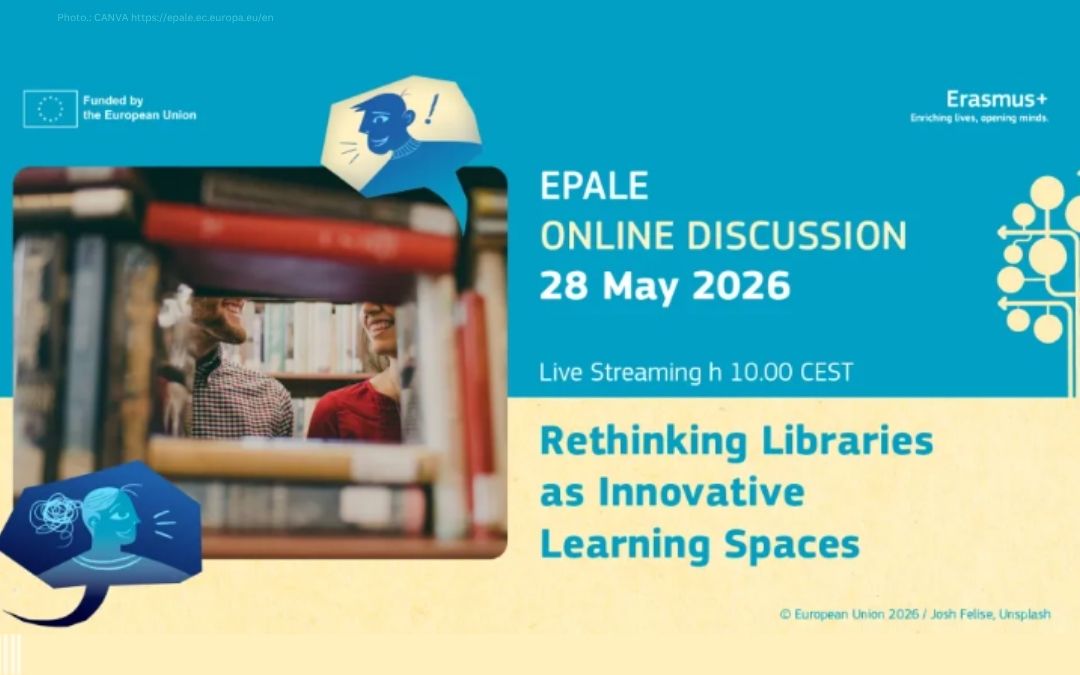
Libraries are increasingly recognised as important learning environments within adult education. Far beyond their traditional role as repositories of knowledge, they are evolving into spaces for dialogue, participation, co-creation and community engagement.
A recent EPALE discussion explored the role of libraries as innovative adult learning environments, highlighting their growing potential to reach diverse learners, including adults with limited basic skills or those who have had negative experiences with formal education. The discussion emphasised how trusted public spaces such as libraries can support inclusion, lifelong learning and civic participation.
The theme is further explored in an EPALE blog on participatory libraries, which demonstrates how libraries can move beyond providing services and become places where users actively shape programmes, collections and learning experiences. Examples from Austria and other countries illustrate how approaches such as Living Libraries, community-led projects, makerspaces and participatory collection development can transform libraries into collaborative learning ecosystems.
For adult education providers, libraries are valuable partners. They offer low-threshold access to learning opportunities, create spaces where formal, non-formal and informal learning intersect and support community building through shared experiences and dialogue. At a time when social cohesion and participation are increasingly important, libraries provide accessible and trusted spaces for learning communities.
The growing emphasis on participation also challenges educators to rethink traditional roles. Instead of being solely providers of knowledge, institutions are increasingly becoming facilitators of shared learning, collective problem-solving and community engagement.
➡ Explore the EPALE discussion on libraries as innovative learning environments
➡ Read the blog on participatory libraries and discover new possibilities for collaboration in adult learning
Špela Močilnikar (spela.mocilnikar@cmepius.si), CMEPIUS; prepared with editorial support from AI tools.