


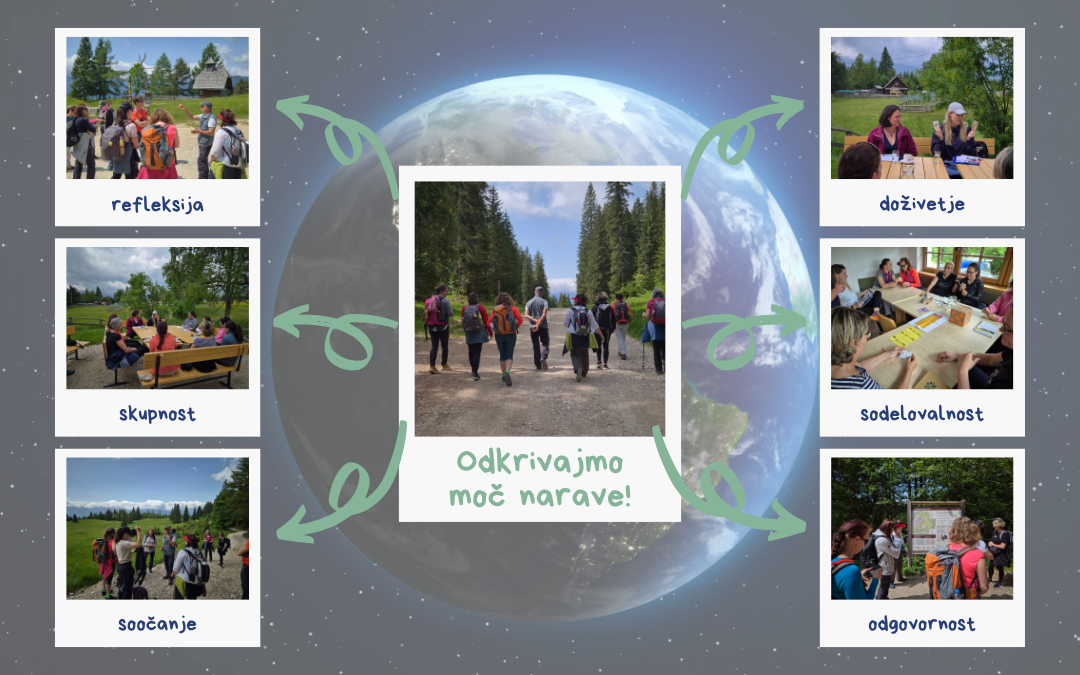
How can we include nature as a partner in adult education? How can we foster the development of green competences – not only through content, but also through methods of delivery, relationships and lived experience? These were the central questions explored in a professional training programme in May and June, attracting numerous adult educators. The aim was to equip participants with the knowledge and skills needed to deliver the nationally recognised programme Discovering the power of nature in their own local environments.
The 32-hour programme was designed to be multi-layered:
- Introductory classroom session – introduced the conceptual foundations of the nationally recognised programme and provided participants with initial theoretical insights.
- Fieldwork – invited participants into nature as learners, observers, researchers and creators.
- Independent work with learning materials offered a theoretical framework and practical exercises with reflection prompts.
- Final group presentations – enabled a collaborative synthesis of the knowledge and insights gained throughout the programme.
The training was far more than a one-way transfer of information – it was an invitation to co-create a space for shared learning. Participants were encouraged to engage actively, reflect deeply and prepare to adapt the programme to their specific contexts. A key takeaway was the realisation that nature does not need to be taught as a subject; it can be invited in as a partner in the learning process.
Nature as challenge and ally
A highlight of the training was the fieldwork on the Uskovnica Plateau, where nature emerged in multiple roles – as a learning space, subject matter and co-participant. This outdoor experience allowed participants to connect theory with practice and fostered an emotional bond with the topic.
The fieldwork was designed as a multi-layered journey. In the first phase, environmental experts shared valuable insights into the complexities of nature conservation, drawing on their extensive knowledge of environmental issues.
In the second phase, participants engaged in reflection through the use of so-called serious games. These allowed them to experience first-hand the dynamics that unfold in real life, where individual interests can lead to the depletion of shared resources. This approach encouraged them to consider how their actions impact the community and the natural environment, and provided space for discussion on ethical dilemmas and personal responsibility.
The very design of the programme Discovering the Power of Nature served as a model for creating a learning experience that is not only informative but also transformative. Its multi-layered structure – blending classroom, online and field-based learning; integrating individual and group work; and combining theory, practice and reflection – created a dynamic and inclusive learning environment. The programme became an example of good practice, showing how learning can be designed holistically, considering diverse learning approaches, the importance of emotional engagement, physical space, interdisciplinary collaboration and a commitment to sustainability. Participants experienced it not merely as a source of content, but as a model they could adapt and transfer into their own contexts when working with different target groups.
Final synthesis: diversity as an asset
The final group presentations of implementation plans for delivering the programme clearly demonstrated that the diversity of approaches was an added value of the training. Each group offered a valuable perspective on how complex and context-sensitive learning must be if it is to be genuinely transformative. Although all groups started from the same initial guidelines, each produced a unique outcome.
Our gratitude goes to both the participants and the trainers for their invaluable contributions to the successful implementation of the programme.
Dr Nevenka Bogataj (nevenka.bogataj@acs.si) and Erika Švara (erika.svara@acs.si), both SIAE