


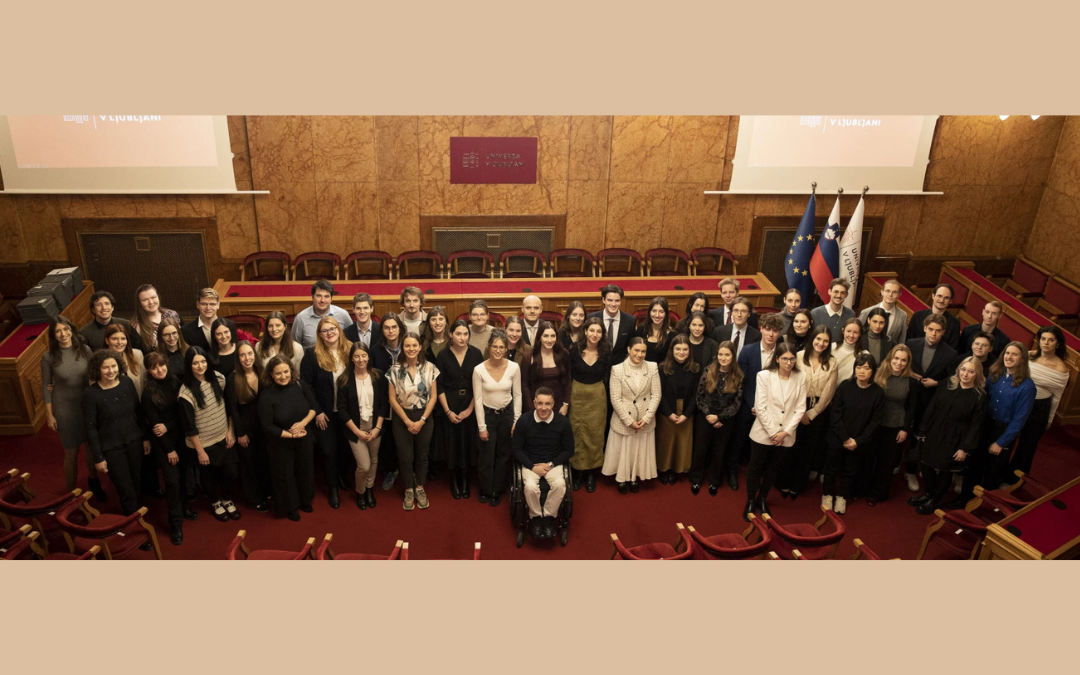
On 10 December 2025, we, students of the Master’s programme in Andragogy at the Faculty of Arts, University of Ljubljana, received an award in recognition of our achievements and active engagement in extracurricular activities. The award was granted for our participation in the project Museum in the Community 2.
The project emerged from a collaboration between the Faculty of Arts and the Academy of Fine Arts and Design. Its aim was to connect the Fužine neighbourhood community with the Museum of Architecture and Design (MAO). Students of Andragogy participated through the course Community Education under the mentorship of Dr Nives Ličen, while Prof Boštjan Botas Kenda mentored students from the Academy of Fine Arts and Design. Both groups worked closely with Maja Šuštaršič, museum adviser and representative of MAO.
Theoretical foundations were provided by Prof Irma Potočnik Slavič and Prof Simon Kušar and were translated into the practical development of a social innovation created with and for the community.
Navigating challenges
The groups were heterogeneous, which presented ongoing challenges. Each group was responsible for a specific project, and students from both faculties worked under significant time constraints alongside a substantial workload. Challenges were therefore inevitable.
Our shared aim was to create something that would genuinely respond to the needs of the community. The work was based on semi-structured interviews with residents of the Fužine neighbourhood. However, perspectives among residents and outsiders can differ considerably. One of the first challenges our group faced was integrating the “two hemispheres” of our team: bringing together different ways of thinking in a complementary, interdisciplinary manner and addressing challenges collectively. Another key question was how to convince students from the Academy of Fine Arts and Design of the relevance of our prior knowledge and earn their trust. At the same time, expectations at the Museum of Architecture and Design were high. Nevertheless, we remained committed to our central objective: to create a public good for the local community.
Trust as the key
Mutual trust developed gradually over time. We succeeded in addressing one of the defining challenges of today: not only accepting differences but transforming them into a valuable resource. When given space to develop, diversity enhances the value of human capital and builds bridges between people. This is invaluable.
Our group also spanned different age groups. As a mature student, I brought a range of life experiences. Initially, this posed a barrier for some. It required considerable mutual patience, understanding and acceptance for us to move forward together. In the end, these experiences proved to be the most valuable. When we find the courage to overcome challenges collectively, the effort is undoubtedly rewarded.
The invaluable support of a mentor
Throughout the process, our mentor, Dr Nives Ličen, provided consistent support, guidance and direction. Her reflections and feedback brought a depth of insight and clarity that only a true expert can offer. Equally important was her strong sense of humanity, which played a vital role in our success.
All these elements, among others, contributed to our achievement. I hope that future projects will continue to embrace such diversity. Recognising, valuing and transforming diversity into added value is fundamental to building a healthy society and fostering global understanding – an aspiration we all share and a responsibility we all carry.
Klementina Berginc Nonino (kb47696@student.uni-lj.si), student of andragogy